

What Is a Health Factor
Every borrowing position on Juncta has a health factor. It is a single number that tells you how safe your position is at any given moment. The higher your health factor, the safer your position. As it falls, your position moves closer to liquidation. Your health factor is calculated as follows: Health Factor = (Collateral Value × Collateral Factor) ÷ Outstanding Borrow Value For example, if your collateral is worth 7,000. If you borrow $5,000, your health factor at entry is: (5,000 = 1.4 A health factor of 1.4 means your collateral would need to lose a significant amount of its value before your position is at risk. The closer your health factor gets to 1.0, the more at risk your position becomes.What Affects Your Health Factor
Your health factor changes continuously based on two things. The value of your collateral. If the market price of your collateral falls, the value of your position falls with it, which lowers your health factor. If you are using an LP position as collateral, impermanent loss can also reduce the value of your collateral over time. Your outstanding borrow. Interest accrues continuously on your loan. As interest builds up, your outstanding borrow value increases, which puts downward pressure on your health factor even if your collateral value stays the same.Monitoring Your Health Factor
Juncta’s dashboard shows your health factor updated every block. You can see its current value, its recent trajectory, and the implied liquidation price — the price at which your collateral value would fall to the point where your health factor reaches 1.0. Check your health factor regularly. During volatile market conditions, collateral values can move quickly and your health factor can deteriorate faster than expected.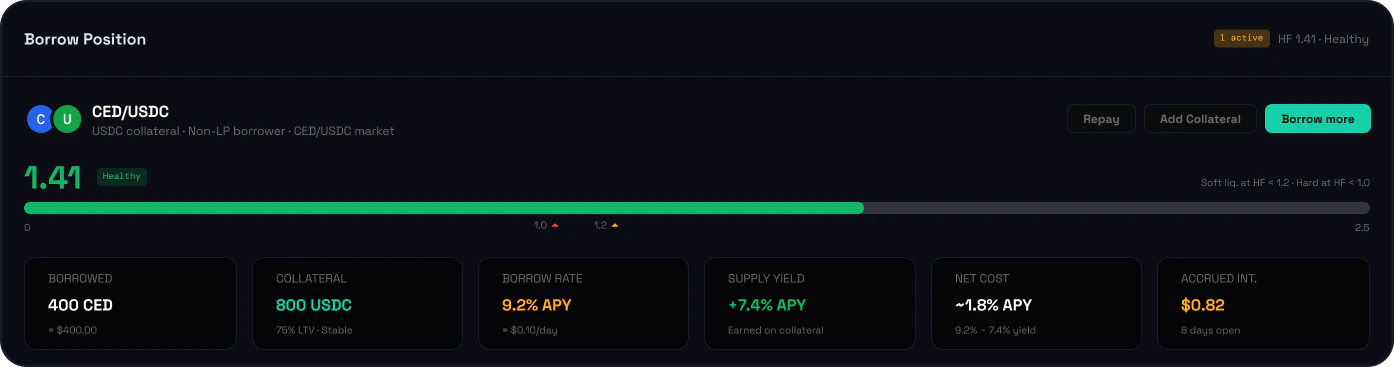
You do not need to wait for your health factor to fall before taking action.
You can improve it at any time by repaying part of your outstanding borrow or
by adding more collateral to your position.
How Liquidation Works on Juncta
Juncta uses a graduated liquidation system rather than a single hard liquidation threshold. Instead of liquidating your full position the moment a threshold is crossed, the protocol responds in stages as your health factor falls, giving you time to act before a full liquidation becomes necessary.Health Factor Tiers
Above 1.2 — Healthy Your position is in good standing. No action is taken by the protocol. 1.2 to 1.1 — Soft Liquidation Begins 10% of your collateral is converted into a lower-risk bin distribution per block. This reduces your exposure gradually rather than all at once. You can still act at this stage to bring your health factor back above 1.2. 1.1 to 1.0 — Soft Liquidation Accelerates The conversion rate increases to 25% of your collateral per block. Your position is at significant risk at this stage. Repaying part of your borrow or adding collateral immediately is strongly recommended. Below 1.0 — Full Liquidation Your position is fully liquidated. A liquidation penalty is applied to your collateral value. To avoid reaching this stage, monitor your health factor closely and act early when it starts to decline.How to Protect Your Position
There are two actions you can take at any time to improve your health factor and reduce your liquidation risk. Repay part of your borrow. Reducing your outstanding borrow value directly improves your health factor. Even a partial repayment can move your position back into a healthy range. Add more collateral. Depositing additional collateral increases the collateral value side of the equation, which raises your health factor. If you are using an LP position as collateral, you can also add a separate collateral deposit on top of it.If your health factor falls below 1.2 and soft liquidation has begun, adding
collateral or repaying your borrow will stop the soft liquidation process and
return your position to a healthy state.